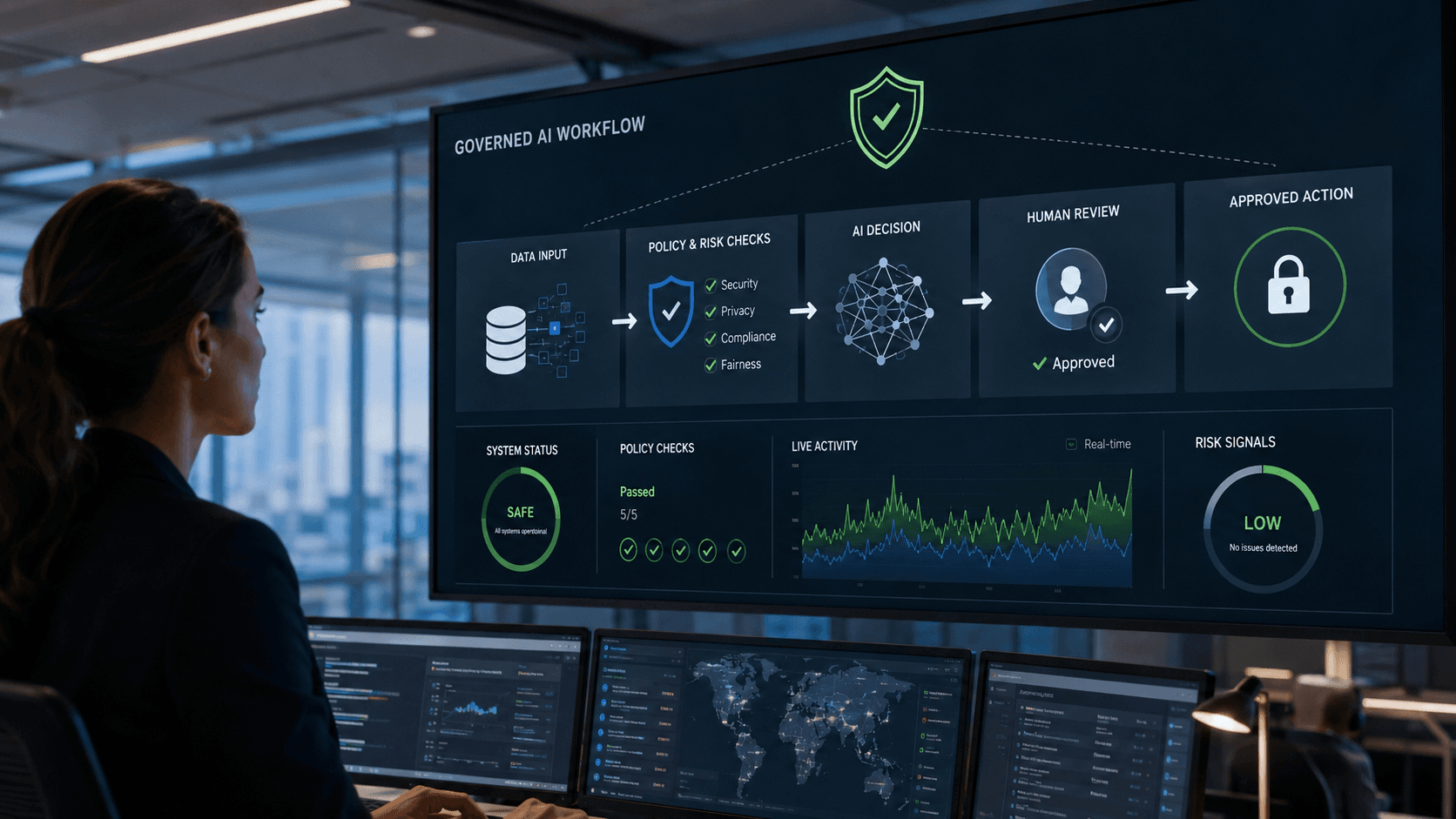
Controlled Speed : The New Standard for Real-Time AI
June 2026


Fast or Safe? Why Real-Time AI Should Not Force You to Choose
Real-time AI is entering environments where every second matters, but speed alone is not enough. When AI becomes part of business operations, industrial workflows, edge systems, or customer-facing decisions, it also needs control, clarity, and trust.
The question is not whether a system should be fast or safe. It has to be both.
Why Speed Alone Is Not Enough
A system that responds instantly but cannot explain its boundaries is not ready for production. As real-time AI moves into serious environments, the cost of an ungoverned fast decision rises with it. A delay might cost you a moment. An unsafe automated action, taken at speed and at scale, can cost far more.
That is why speed, on its own, is the wrong thing to optimize for. The goal is a system that is fast and knows its limits: what it is allowed to do, what data it should touch, and when a human should be involved.
Safety Built Into Architecture Is Not Slower
There is a common assumption that adding safety slows a system down. In a well-architected system, it does not, because the safety lives in the design rather than as a layer bolted on at runtime.
Validating input as it streams in does not meaningfully slow a system built to expect it. Scoping a component's permissions to exactly what it needs costs design discipline up front, not latency. Designing for failure, so the system recovers cleanly instead of corrupting state, makes the whole system more dependable under load without slowing the path that matters. The work happens at design time, which is exactly why it does not show up as lag.
Controlled Speed in Real-Time AI
At Aiotrix, we see real-time AI as an engineering discipline, not just an intelligence layer. A system should respond quickly, but it should also understand its boundaries. It should process data fast, but it should not move sensitive information unnecessarily. It should automate decisions, but only within clear rules, permissions, and human oversight where it matters.
We call this controlled speed: the ability to move fast without losing control. It is the standard real-time AI needs when it moves from demos into production.
What Businesses Should Expect
When you deploy real-time AI into your operations, you should not have to settle for "fast but risky" or "safe but sluggish." A system built correctly gives you responsiveness and control together, because both were requirements from the start.
You should expect a system that acts within clear boundaries, keeps sensitive data where it belongs, recovers cleanly when infrastructure fails, and brings a human into the loop for the decisions that warrant one. Those are not premium add-ons. They are what production-grade should mean.
How Aiotrix Builds With This Standard
We treat controlled speed as the baseline for the systems we build, real-time AI, edge intelligence, and industrial automation designed to run in the real world, not just in a demo.
We do not claim any system is invulnerable; no honest engineering team would. What we commit to is building so that speed never comes at the cost of control. That is the standard we hold our work to, and it is the difference between a system that performs on stage and one you can actually run your business on.
Built in Mangalore. Built for the world.